What monetary policy should be implemented to correct an inflationary economy brainly
xi.2 Problems and Controversies of Budgetary Policy
Learning Objectives
- Explain the three kinds of lags that can influence the effectiveness of monetary policy.
- Identify the macroeconomic targets at which the Fed tin can aim in managing the economy, and hash out the difficulties inherent in using each of them as a target.
- Discuss how each of the following influences a central bank's ability to reach its desired macroeconomic outcomes: political pressures, the degree of impact on the economy (including the situation of a liquidity trap), and the rational expectations hypothesis.
The Fed has some obvious advantages in its acquit of budgetary policy. The 2 policy-making bodies, the Board of Governors and the Federal Open Market Committee (FOMC), are small and largely contained from other political institutions. These bodies can thus reach decisions quickly and implement them immediately. Their relative independence from the political process, together with the fact that they run across in hole-and-corner, allows them to operate outside the glare of publicity that might otherwise be focused on bodies that wield such enormous power.
Despite the apparent ease with which the Fed can comport monetary policy, it still faces difficulties in its efforts to stabilize the economic system. We examine some of the problems and uncertainties associated with monetary policy in this section.
Lags
Perchance the greatest obstruction facing the Fed, or any other central bank, is the problem of lags. It is like shooting fish in a barrel enough to show a recessionary gap on a graph so to show how monetary policy can shift aggregate need and close the gap. In the real world, all the same, it may take several months before anyone even realizes that a particular macroeconomic trouble is occurring. When budgetary authorities become aware of a problem, they can deed quickly to inject reserves into the arrangement or to withdraw reserves from it. One time that is done, however, it may be a year or more earlier the action affects aggregate demand.
The delay betwixt the fourth dimension a macroeconomic problem arises and the time at which policy makers become aware of it is called a recognition lag. The 1990–1991 recession, for example, began in July 1990. It was not until belatedly Oct that members of the FOMC noticed a slowing in economic activity, which prompted a stimulative monetary policy. In dissimilarity, the nearly recent recession began in Dec 2007, and Fed easing began in September 2007.
Recognition lags stalk largely from problems in collecting economic data. First, data are available only later the conclusion of a particular menses. Preliminary estimates of existent Gdp, for example, are released near a month after the end of a quarter. Thus, a change that occurs early in a quarter will not be reflected in the data until several months later. 2nd, estimates of economical indicators are subject to revision. The first estimates of real GDP in the tertiary quarter of 1990, for case, showed it increasing. Not until several months had passed did revised estimates prove that a recession had begun. And finally, different indicators tin lead to different interpretations. Data on employment and retail sales might be pointing in one management while data on housing starts and industrial production might be pointing in another. Information technology is 1 thing to wait dorsum afterward a few years have elapsed and make up one's mind whether the economy was expanding or contracting. It is quite some other to decipher changes in existent Gross domestic product when 1 is right in the middle of events. Fifty-fifty in a world chock with figurer-generated data on the economy, recognition lags can exist substantial.
Just after policy makers recognize there is a problem can they take activeness to deal with information technology. The delay betwixt the fourth dimension at which a trouble is recognized and the time at which a policy to bargain with it is enacted is chosen the implementation lag. For monetary policy changes, the implementation lag is quite brusk. The FOMC meets viii times per twelvemonth, and its members may confer between meetings through conference calls. Once the FOMC determines that a policy change is in order, the required open-market operations to buy or sell federal bonds can be put into issue immediately.
Policy makers at the Fed still have to contend with the impact lag, the filibuster betwixt the fourth dimension a policy is enacted and the fourth dimension that policy has its impact on the economic system.
The impact lag for monetary policy occurs for several reasons. First, it takes some time for the deposit multiplier process to work itself out. The Fed can inject new reserves into the economic system immediately, only the deposit expansion process of bank lending will need fourth dimension to have its total effect on the coin supply. Interest rates are afflicted immediately, but the money supply grows more slowly. 2d, firms demand some time to respond to the monetary policy with new investment spending—if they reply at all. 3rd, a budgetary change is probable to touch the substitution rate, merely that translates into a change in internet exports only after some delay. Thus, the shift in the amass demand curve due to initial changes in investment and in cyberspace exports occurs after some delay. Finally, the multiplier procedure of an expenditure change takes time to unfold. It is simply every bit incomes start to rise that consumption spending picks up.
The problem of lags suggests that monetary policy should respond non to statistical reports of economic conditions in the recent past just to weather expected to be in the time to come. In justifying the imposition of a contractionary monetary policy early in 1994, when the economic system still had a recessionary gap, Greenspan indicated that the Fed expected a i-twelvemonth impact lag. The policy initiated in 1994 was a response not to the economical weather condition thought to be at the time but to conditions expected to exist in 1995. When the Fed used contractionary policy in the middle of 1999, it argued that it was doing and so to forestall a possible increment in aggrandizement. When the Fed began easing in September 2007, information technology argued that it was doing so to forestall adverse furnishings to the economy of falling housing prices. In these examples, the Fed appeared to be looking forwards. It must exercise and then with information and forecasts that are far from perfect.
Estimates of the length of time required for the affect lag to work itself out range from six months to two years. Worse, the length of the lag tin vary—when they have action, policy makers cannot know whether their choices volition bear upon the economy within a few months or within a few years. Considering of the uncertain length of the bear upon lag, efforts to stabilize the economy through monetary policy could be destabilizing. Suppose, for instance, that the Fed responds to a recessionary gap with an expansionary policy merely that by the time the policy begins to affect aggregate need, the economy has already returned to potential GDP. The policy designed to right a recessionary gap could create an inflationary gap. Similarly, a shift to a contractionary policy in response to an inflationary gap might non bear on aggregate demand until later on a cocky-correction process had already closed the gap. In that case, the policy could plunge the economy into a recession.
Choosing Targets
In attempting to manage the economy, on what macroeconomic variables should the Fed base its policies? It must have some target, or fix of targets, that it wants to attain. The failure of the economy to reach one of the Fed's targets would then trigger a shift in monetary policy. The option of a target, or set of targets, is a crucial one for monetary policy. Possible targets include interest rates, coin growth rates, and the cost level or expected changes in the price level.
Interest Rates
Interest rates, especially the federal funds rate, played a key function in recent Fed policy. The FOMC does not decide to increase or decrease the money supply. Rather, it engages in operations to nudge the federal funds rate up or down.
Up until August 1997, information technology had instructed the trading desk-bound at the New York Federal Reserve Bank to carry open-marketplace operations in a manner that would either maintain, increment, or ease the current "degree of pressure level" on the reserve positions of banks. That degree of pressure level was reflected by the federal funds charge per unit; if existing reserves were less than the amount banks wanted to hold, then the behest for the available supply would send the federal funds rate upwardly. If reserves were plentiful, so the federal funds charge per unit would tend to turn down. When the Fed increased the degree of pressure on reserves, information technology sold bonds, thus reducing the supply of reserves and increasing the federal funds rate. The Fed decreased the caste of pressure on reserves by buying bonds, thus injecting new reserves into the system and reducing the federal funds rate.
The current operating procedures of the Fed focus explicitly on interest rates. At each of its eight meetings during the twelvemonth, the FOMC sets a specific target or target range for the federal funds rate. When the Fed lowers the target for the federal funds rate, it buys bonds. When it raises the target for the federal funds rate, it sells bonds.
Money Growth Rates
Until 2000, the Fed was required to announce to Congress at the kickoff of each year its target for money growth that twelvemonth and each report dutifully did so. At the same time, the Fed written report would mention that its money growth targets were benchmarks based on historical relationships rather than guides for policy. Equally shortly as the legal requirement to report targets for money growth ended, the Fed stopped doing so. Since in recent years the Fed has placed more importance on the federal funds rate, it must adjust the money supply in gild to motility the federal funds rate to the level it desires. As a result, the money growth targets tended to fall by the wayside, fifty-fifty over the concluding decade in which they were existence reported. Instead, as data on economic conditions unfolded, the Fed made, and continues to make, adjustments in gild to affect the federal funds involvement charge per unit.
Price Level or Expected Changes in the Cost Level
Some economists argue that the Fed'due south main goal should be price stability. If then, an obvious possible target is the toll level itself. The Fed could target a particular price level or a particular rate of change in the price level and adapt its policies appropriately. If, for case, the Fed sought an inflation rate of 2%, then it could shift to a contractionary policy whenever the rate rose higher up two%. I difficulty with such a policy, of grade, is that the Fed would be responding to by economical conditions with policies that are not likely to affect the economy for a year or more. Some other difficulty is that aggrandizement could exist rising when the economic system is experiencing a recessionary gap. An example of this, mentioned before, occurred in 1990 when inflation increased due to the seemingly temporary increase in oil prices following Iraq'south invasion of Kuwait. The Fed faced a like situation in the first half of 2008 when oil prices were again ascension. If the Fed undertakes contractionary monetary policy at such times, then its efforts to reduce the inflation charge per unit could worsen the recessionary gap.
The solution proposed by Chairman Bernanke, who is an abet of inflation rate targeting, is to focus not on the past rate of inflation or even the current rate of inflation, merely on the expected rate of aggrandizement, every bit revealed by various indicators, over the next year.
By 2010, the primal banks of most thirty developed or developing countries had adopted specific inflation targeting. Inflation targeters include Commonwealth of australia, Brazil, Canada, Great Britain, New Zealand, South Korea, and, most recently, Turkey and Republic of indonesia. A written report by economist Carl Walsh found that inflationary experiences among developed countries have been similar, regardless of whether their central banks had explicit or more flexible inflation targets. For developing countries, notwithstanding, he institute that inflation targeting enhanced macroeconomic performance, in terms of both lower inflation and greater overall stability (Walsh, 2009).
Political Pressures
The institutional relationship between the leaders of the Fed and the executive and legislative branches of the federal government is structured to provide for the Fed'southward independence. Members of the Board of Governors are appointed past the president, with confirmation by the Senate, merely the 14-year terms of office provide a considerable caste of insulation from political pressure. A president exercises greater influence in the choice of the chairman of the Lath of Governors; that engagement carries a four-year term. Neither the president nor Congress has any directly say over the choice of the presidents of Federal Reserve commune banks. They are chosen by their individual boards of directors with the approval of the Board of Governors.
The degree of independence that fundamental banks around the world accept varies. A cardinal banking concern is considered to be more than independent if it is insulated from the regime past such factors as longer term appointments of its governors and fewer requirements to finance authorities budget deficits. Studies in the 1980s and early 1990s showed that, in general, greater key bank independence was associated with lower average inflation and that there was no systematic relationship betwixt cardinal banking company independence and other indicators of economical performance, such equally existent GDP growth or unemployment (Alesina & Summers, 1993). By the rankings used in those studies, the Fed was considered quite contained, 2nd only to Switzerland and the German language Bundesbank at the fourth dimension. Peradventure equally a result of such findings, a number of countries take granted greater independence to their cardinal banks in the last decade. The charter for the European Central Banking concern, which began operations in 1998, was modeled on that of the German Bundesbank. Its charter states explicitly that its primary objective is to maintain price stability. Also, since 1998, central bank independence has increased in the Britain, Canada, Nippon, and New Zealand.
While the Fed is formally insulated from the political process, the men and women who serve on the Board of Governors and the FOMC are homo beings. They are not immune to the pressures that can exist placed on them by members of Congress and by the president. The chairman of the Board of Governors meets regularly with the president and the executive staff and too reports to and meets with congressional committees that deal with economic matters.
The Fed was created by the Congress; its charter could be contradistinct—or even revoked—by that same body. The Fed is in the somewhat paradoxical situation of having to cooperate with the legislative and executive branches in order to preserve its independence.
The Degree of Impact on the Economy
The problem of lags suggests that the Fed does non know with certainty when its policies will work their way through the financial organisation to have an bear on on macroeconomic functioning. The Fed also does not know with certainty to what extent its policy decisions will affect the macroeconomy.
For example, investment tin can be particularly volatile. An effort by the Fed to reduce aggregate demand in the face of an inflationary gap could be partially showtime past ascension investment demand. But, generally, contractionary policies do tend to ho-hum down the economy as if the Fed were "pulling on a rope." That may non exist the example with expansionary policies. Since investment depends crucially on expectations nearly the future, business organization leaders must be optimistic about economical weather condition in club to expand production facilities and buy new equipment. That optimism might non be in a recession. Instead, the pessimism that might prevail during an economical slump could forestall lower interest rates from stimulating investment. An try to stimulate the economy through monetary policy could exist like "pushing on a string." The key bank could push with great force by buying bonds and engaging in quantitative easing, but little might happen to the economy at the other stop of the cord.
What if the Fed cannot bring most a change in interest rates? A liquidity trap is said to exist when a change in budgetary policy has no effect on involvement rates. This would exist the case if the money demand curve were horizontal at some interest rate, as shown in Figure eleven.4 "A Liquidity Trap". If a modify in the coin supply from Yard to M′ cannot change interest rates, and then, unless at that place is some other change in the economy, there is no reason for investment or any other component of aggregate demand to alter. Hence, traditional monetary policy is rendered totally ineffective; its caste of touch on on the economy is nil. At an interest rate of cypher, since bonds finish to exist an attractive alternative to money, which is at to the lowest degree useful for transactions purposes, there would be a liquidity trap.
Figure eleven.4 A Liquidity Trap
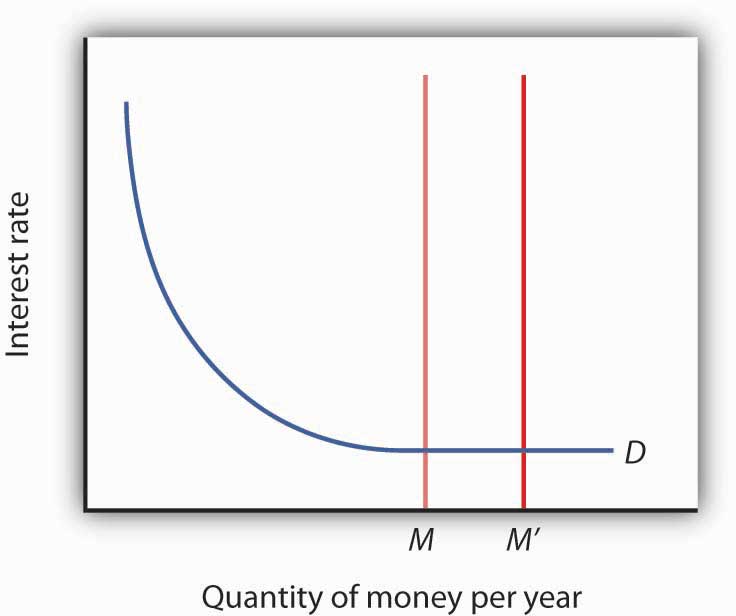
When a change in the money supply has no effect on the interest rate, the economy is said to exist in a liquidity trap.
With the federal funds rate in the United States close to zero at the end of 2008, the possibility that the country was in or nearly in a liquidity trap could non exist dismissed. Every bit discussed in the introduction to the chapter, at the aforementioned fourth dimension the Fed lowered the federal funds rate to shut to zero, it mentioned that it intended to pursue additional, nontraditional measures. What the Fed seeks to do is to make firms and consumers want to spend now by using a tool not aimed at reducing the involvement rate, since it cannot reduce the involvement charge per unit below aught. It thus shifts its focus to the price level and to avoiding expected deflation. For example, if the public expects the cost level to fall by 2% and the interest charge per unit is zilch, by belongings money, the money is actually earning a positive real interest rate of ii%—the difference betwixt the nominal involvement rate and the expected deflation rate. Since the nominal rate of interest cannot fall below null (Who would, for example, desire to lend at an interest charge per unit below nix when lending is risky whereas cash is not? In brusque, it does non make sense to lend $ten and get less than $10 back.), expected deflation makes holding cash very attractive and discourages spending since people volition put off purchases because goods and services are expected to become cheaper.
To combat this "await-and-run into" mentality, the Fed or another central banking company, using a strategy referred to as quantitative easing, must convince the public that it will go along interest rates very depression by providing substantial reserves for as long as is necessary to avoid deflation. In other words, it is aimed at creating expected inflation. For example, at the Fed's October 2003 coming together, it announced that it would go on the federal funds rate at one% for "a considerable period." When the Fed lowered the rate to between 0% and 0.25% in December 2008, it added that "the committee anticipates that weak economic atmospheric condition are probable to warrant exceptionally low levels of the federal funds rate for some time." Subsequently working then hard to convince economic players that it will not tolerate inflation above ii%, the Fed, when in such a situation, must convince the public that it will tolerate inflation, simply of form not too much! If it is successful, this extraordinary grade of expansionary monetary policy volition lead to increased purchases of goods and services, compared to what they would have been with expected deflation. Also, by providing banks with lots of liquidity, the Fed is hoping to encourage them to lend.
The Japanese economy provides an interesting mod case of a country that attempted quantitative easing. With a recessionary gap starting in the early 1990s and deflation in almost years from 1995 on, Japan's central bank, the Bank of Japan, began to lower the phone call money rate (equivalent to the federal funds rate in the Usa), reaching near zilch by the late 1990s. With growth still languishing, Nippon appeared to exist in a traditional liquidity trap. In tardily 1999, the Bank of Japan appear that it would maintain a zero interest charge per unit policy for the foreseeable future, and in March 2001 it officially began a policy of quantitative easing. In 2006, with the price level rising modestly, Nippon ended quantitative easing and began increasing the call rate over again. Information technology should be noted that the government simultaneously engaged in expansionary fiscal policy.
How well did these policies work in Nihon? The economy began to abound modestly in 2003, though deflation between 1% and 2% remained. Some researchers feel that the Banking concern of Japan ended quantitative easing too early. Also, delays in implementing the policy, too as delays in restructuring the cyberbanking sector, exacerbated Japan's bug.[one]
Fed Chairman Bernanke and other Fed officials accept argued that the Fed is also engaged in credit easing (Bernanke, 2009; Yellen, 2009). Credit easing is a strategy that involves the extension of central bank lending to influence more than broadly the proper performance of credit markets and to better liquidity. The specific new credit facilities that the Fed has created were discussed in the Instance in Point in the chapter on the nature and creation of money. In general, the Fed is hoping that these new credit facilities will meliorate liquidity in a variety of credit markets, ranging from those used past money market mutual funds to those involved in student and car loans.
Rational Expectations
Ane hypothesis suggests that budgetary policy may bear upon the toll level but not real GDP. The rational expectations hypothesis states that people use all bachelor information to make forecasts nigh time to come economical activity and the price level, and they adjust their behavior to these forecasts.
Figure eleven.v "Monetary Policy and Rational Expectations" uses the model of amass need and amass supply to show the implications of the rational expectations argument for budgetary policy. Suppose the economy is operating at Y P, equally illustrated by point A. An increase in the coin supply boosts amass demand to Advertizement 2. In the analysis we take explored thus far, the shift in aggregate need would movement the economic system to a higher level of real Gdp and create an inflationary gap. That, in turn, would put upward force per unit area on wages and other prices, shifting the short-run amass supply curve to SRAS two and moving the economy to bespeak B, closing the inflationary gap in the long run. The rational expectations hypothesis, however, suggests a quite different interpretation.
Effigy 11.v Monetary Policy and Rational Expectations
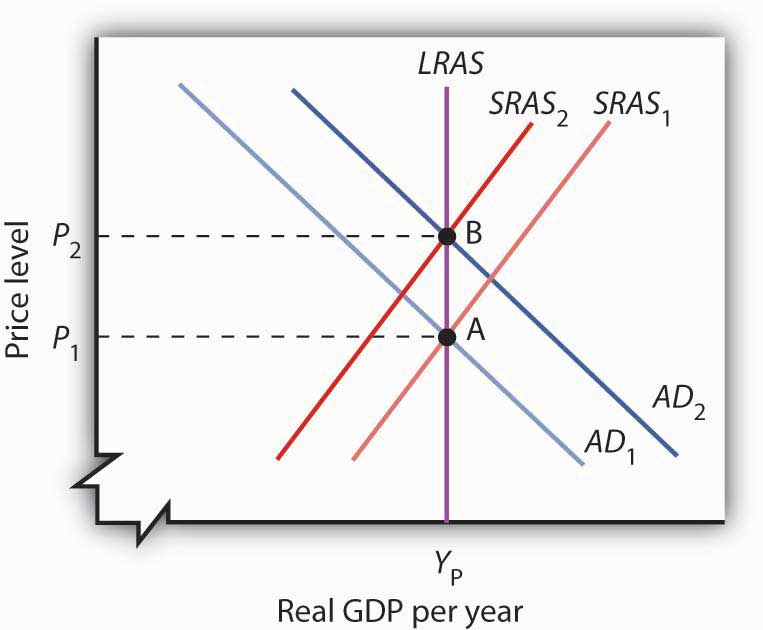
Suppose the economy is operating at point A and that individuals accept rational expectations. They calculate that an expansionary budgetary policy undertaken at cost level P 1 will heighten prices to P ii. They adjust their expectations—and wage demands—accordingly, quickly shifting the short-run aggregate supply curve to SRAS 2. The outcome is a movement forth the long-run aggregate supply curve LRAS to betoken B, with no change in real Gdp.
Suppose people observe the initial monetary policy change undertaken when the economy is at point A and calculate that the increase in the money supply will ultimately drive the toll level upward to point B. Anticipating this change in prices, people conform their behavior. For case, if the increment in the cost level from P 1 to P 2 is a 10% modify, workers volition conceptualize that the prices they pay will ascent 10%, and they will demand x% higher wages. Their employers, anticipating that the prices they volition receive volition besides rise, will agree to pay those higher wages. As nominal wages increment, the short-run aggregate supply curve immediately shifts to SRAS 2. The result is an upward movement along the long-run aggregate supply curve, LRAS. At that place is no change in real Gross domestic product. The monetary policy has no outcome, other than its impact on the price level. This rational expectations argument relies on wages and prices beingness sufficiently flexible—not sticky, equally described in an before chapter—so that the modify in expectations will let the short-run aggregate supply bend to shift chop-chop to SRAS 2.
1 important implication of the rational expectations argument is that a contractionary monetary policy could exist painless. Suppose the economy is at point B in Figure eleven.5 "Monetary Policy and Rational Expectations", and the Fed reduces the money supply in order to shift the amass demand curve back to AD 1. In the model of amass demand and aggregate supply, the result would exist a recession. But in a rational expectations globe, people'southward expectations alter, the short-run aggregate supply immediately shifts to the right, and the economic system moves painlessly down its long-run aggregate supply bend LRAS to point A. Those who support the rational expectations hypothesis, even so, besides tend to argue that monetary policy should not be used as a tool of stabilization policy.
For some, the events of the early 1980s weakened back up for the rational expectations hypothesis; for others, those same events strengthened support for this hypothesis. As we saw in the introduction to an earlier affiliate, in 1979 President Jimmy Carter appointed Paul Volcker as Chairman of the Federal Reserve and pledged his full support for whatever the Fed might practise to contain aggrandizement. Mr. Volcker made it clear that the Fed was going to dull money growth and boost involvement rates. He best-selling that this policy would have costs merely said that the Fed would stick to information technology every bit long as necessary to control inflation. Here was a budgetary policy that was clearly announced and carried out as advertised. But the policy brought on the near astringent recession since the Great Depression—a event that seems inconsistent with the rational expectations argument that changing expectations would prevent such a policy from having a substantial issue on real GDP.
Others, however, argue that people were aware of the Fed'southward pronouncements but were skeptical nigh whether the anti-inflation endeavour would persist, since the Fed had not vigorously fought aggrandizement in the late 1960s and the 1970s. Against this history, people adjusted their estimates of inflation downwards slowly. In essence, the recession occurred considering people were surprised that the Fed was serious nigh fighting aggrandizement.
Regardless of where one stands on this argue, one message does seem clear: once the Fed has proved information technology is serious about maintaining price stability, doing so in the hereafter gets easier. To put this in concrete terms, Volcker'south fight fabricated Greenspan'southward work easier, and Greenspan's legacy of low inflation should make Bernanke's easier.
Cardinal Takeaways
- Macroeconomic policy makers must debate with recognition, implementation, and touch lags.
- Potential targets for macroeconomic policy include interest rates, money growth rates, and the price level or expected rates of change in the price level.
- Even if a central bank is structured to be contained of political pressure, its officers are likely to be affected by such pressure.
- To counteract liquidity traps or the possibility thereof, central banks have used quantitative-easing and credit-easing strategies.
- No central bank can know in accelerate how its policies will impact the economy; the rational expectations hypothesis predicts that central bank actions will impact the coin supply and the price level but not the real level of economic activity.
Endeavor It!
The scenarios below draw the U.S. recession and recovery in the early 1990s. Identify the lag that may have contributed to the difficulty in using monetary policy as a tool of economic stabilization.
- The U.S. economy entered into a recession in July 1990. The Fed countered with expansionary budgetary policy in Oct 1990, ultimately lowering the federal funds rate from viii% to 3% in 1992.
- Investment began to increase, although slowly, in early on 1992, and surged in 1993.
Case in Point: The Fed and the ECB: A Tale of Divergent Monetary Policies
In the leap of 2011, the European Central Banking concern (ECB) began to raise interest rates, while the Federal Reserve Bank held fast to its low rate policy. With the economies of both Europe and the The states weak, why the split in direction?
For 1 thing, at the time, the U.Southward. economic system looked weaker than did Europe's economic system equally a whole. Moreover, the recession in the United states had been deeper. For example, the unemployment charge per unit in the Usa more than than doubled during the Bang-up Recession and its aftermath, while in the eurozone, it had risen only forty%.
Only the divergence also reflected the different legal environments in which the ii central banks operate. The ECB has a clear mandate to fight inflation, while the Fed has more leeway in pursuing both toll stability and full employment. The ECB has a specific inflation target, and the inflation measure it uses covers all prices. The Fed, with its more flexible inflation target, has tended to focus on "cadre" inflation, which excludes gasoline and nutrient prices, both of which are apt to exist volatile. Using each central bank's preferred inflation measure out, European inflation was, at the fourth dimension of the ECB rate hike, running at 2.6%, while in the Usa, it was at 1.half dozen%.
Europe also differs from the U.s.a. in its degree of unionization. Because of Europe's higher level of unionization and commonage bargaining, there is a sense that any cost increases in Europe volition translate into sustained inflation more rapidly there than they will in the United states of america.
Recall, however, that the eurozone is made up of 17 diverse countries. As fabricated evident by the headline news from well-nigh of 2011 and into 2012, a number of countries in the eurozone were experiencing sovereign debt crises (meaning that there was fear that their governments could non meet their debt obligations) as well as more astringent economic conditions. Higher involvement rates make their circumstances that much more difficult. While it is true that various states in the United States can feel very different economic circumstances when the Fed sets what is essentially a "national" monetary policy, having a unmarried monetary policy for different countries presents additional issues. Ane reason for this this difference is that labor mobility is higher in the United States than it is across the countries of Europe. Also, the United States can use its "national" fiscal policy to aid weaker states.
In the fall of 2011, the ECB reversed course. At its first coming together under its new president, Mario Draghi, in November 2011, it lowered rates, citing slower growth and growing concerns almost the sovereign debt crunch. A further rate cut followed in December. Interestingly, the inflation charge per unit at the fourth dimension of the cuts was running at nigh iii%, which was above the ECB'southward stated goal of 2%. The ECB argued that it was forecasting lower inflation for the time to come. And then even the ECB has some flexibility and room for discretion.
Sources: Emily Kaiser and Mark Felsenthal, "Seven Reasons Why the Fed Won't Follow the ECB," Reuters Business and Fiscal News, Apr 7, 2011, available http://www.reuters.com/article/2011/04/07/us-united states of america-fed-ecb-idUSTRE73663420110407; David Mchugh, "ECB Cuts Key Rate a Quarter Point to Aid Economy," USA Today, Dec 8, 2011, bachelor http://world wide web.usatoday.com/money/economy/story/2011-12-08/ecb-rate-cut/51733442/1; Fernanda Nechio, "Monetary Policy When One Size Does Not Fit All," Federal Reserve Banking concern of San Francisco Economic Letter, June thirteen, 2011.
Answers to Try It! Problems
- The recognition lag: the Fed did not seem to "recognize" that the economy was in a recession until several months later on the recession began.
- The impact lag: investment did not selection upward chop-chop after interest rates were reduced. Alternatively, it could be attributed to the expansionary budgetary policy'south not having its desired effect, at least initially, on investment.
References
Alesina, A. and Lawrence H. Summers, "Central Bank Independence and Macroeconomic Performance: Some Comparative Evidence," Journal of Money, Credit, and Banking 25, no. ii (May 1993): 151–62.
Bernanke, Due south., "The Crisis and the Policy Response" (Stamp Lecture, London School of Economics, London, England, January 13, 2009).
Walsh, C. E., "Inflation Targeting: What Have We Learned?," International Finance 12, no. two (2009): 195–233.
Yellen, J. L., "U.Due south. Monetary Policy Objectives in the Short Run and the Long Run" (voice communication, Allied Social Sciences Association almanac meeting, San Francisco, California, January iv, 2009).
Source: https://open.lib.umn.edu/macroeconomics/chapter/11-2-problems-and-controversies-of-monetary-policy/
0 Response to "What monetary policy should be implemented to correct an inflationary economy brainly"
Postar um comentário